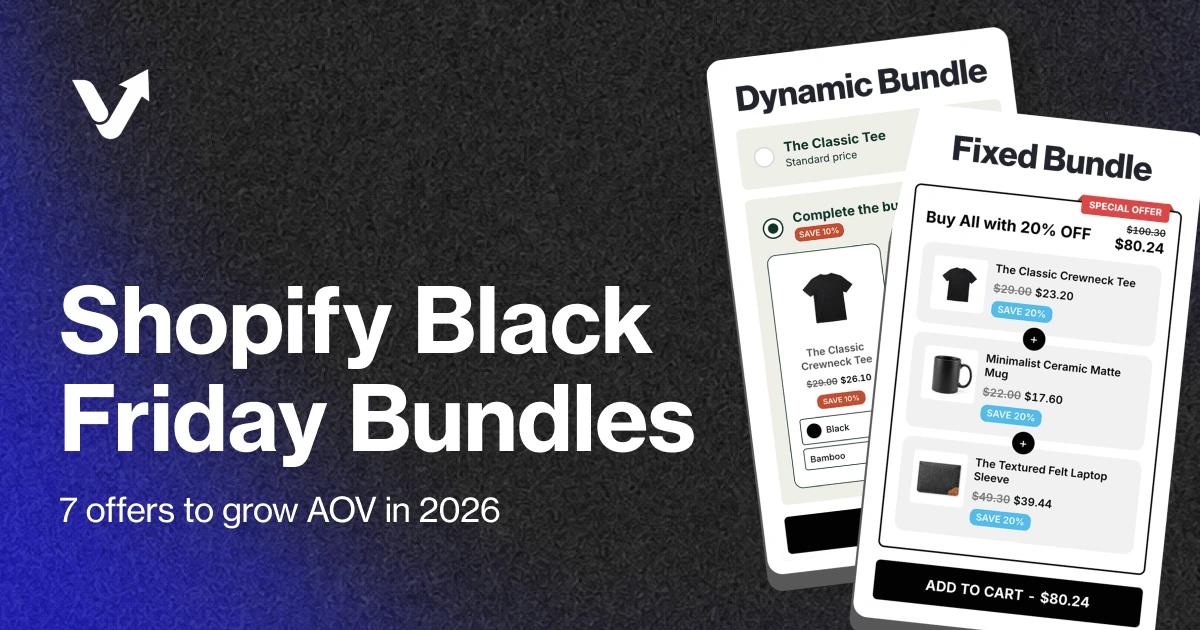
Black Friday 2026 falls on November 27, and Cyber Monday follows on November 30. A Black Friday bundle is a limited-time offer that sells products or quantities together at a better price than buying them separately, such as "buy 3, save 20%" or a complete skincare routine at one price. Shopify Black Friday bundles are one of the most practical ways to prepare for that weekend: instead of cutting the price of every product by the same amount, you structure the offer so the best deal goes to shoppers who build a bigger order.
The opportunity is large. Shopify merchants generated a record $14.6 billion in sales during Black Friday Cyber Monday 2025, up 27% from 2024, with an average cart price of $114.70. More than 94,900 merchants had their highest-selling day ever, and the top categories were cosmetics, clothing, activewear, and fitness and nutrition, all categories where multi-unit offers and bundles are common. Traffic is only half of that equation, though. What each shopper puts in the cart decides how much of that weekend's revenue turns into profit.
This guide covers seven Black Friday bundle offers you can run on Shopify, when each one fits, the margin math that separates a profitable bundle from an expensive one, and a timeline for getting everything built and tested before November.
Black Friday bundle ideas at a glance
| Offer | Example | Best for |
|---|---|---|
| Quantity breaks | Buy 2, save 10%. Buy 3, save 20% | Consumables and products people stock up on |
| Fixed product bundle | Complete routine for $69 instead of $84 | Complementary products |
| Buy X Get Y (BOGO) | Buy 2, get 1 free | Products with healthy margins, inventory you need to move |
| Free gift | Buy the 3-pack, get a free travel pouch | Adding value without deepening the discount |
| Mix and match | Pick any 3 for $59 | Catalogs with many flavors, scents, or colors |
| Add-ons and cross-sells | Add the travel bag for $9 | Accessories that complete the main purchase |
| Subscription bundle | Subscribe and save 20% | Replenishable products |
No single offer works for every store. The goal is to match the promotion to how customers already buy from you. If you are new to bundling, start with our guide on how to create product bundles on Shopify, which compares the native options with dedicated apps.
1. Quantity breaks: reward the bigger order
A site-wide discount gives the same reward whether someone buys one product or five. Quantity breaks make the discount grow with the order, so the shopper who planned to buy one has a reason to consider two or three.
Take a supplement that normally sells for $30:
| Quantity | Offer | Order value |
|---|---|---|
| Buy 1 | Regular price | $30 |
| Buy 2 | Save 10% | $54 |
| Buy 3 | Save 20% | $72 |
The strongest discount still exists, but it sits on the order that can afford it. That is the core difference from "20% off everything."
Quantity breaks fit anything customers can reasonably stock up on: supplements, skincare, coffee, pet food, snacks, cosmetics, and household products. They also work for giftable items during Black Friday. Few people need three candles for themselves, but three candles make sense four weeks before the holidays.
Here is a three-tier quantity break built in V Bundles, with a variant picker for each unit in the pack:
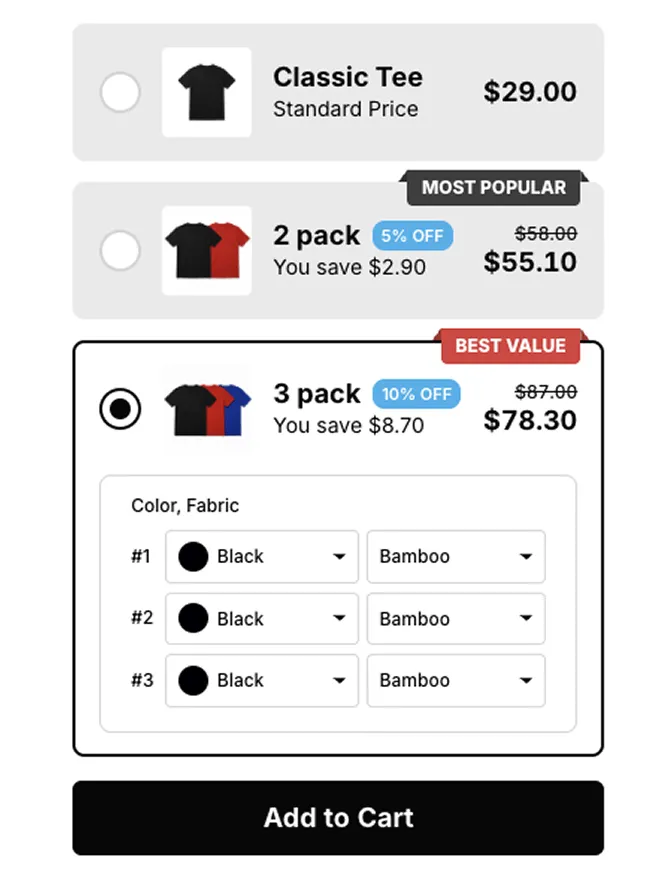
Keep the tiers simple. Two or three tiers are easier to read on a phone than five, and the jump between them should feel obvious. For a deeper look at tier structure and profit-safe discount depth, read our quantity breaks and volume discounts guide before you set your Black Friday pricing.
2. Fixed product bundles: sell the complete set
Some products make more sense together than apart. A skincare store might sell a cleanser for $24, a serum for $32, and a moisturizer for $28. Bought separately, that is $84. As a Black Friday bundle, the complete routine could be $69.
The customer saves $15, and a single-product visit becomes a three-product order. The offer is also easier to understand than a percentage. "Save 18%" asks the shopper to do math; "Get the complete routine for $69" tells them what they get.
Fixed bundles work well for beauty routines, coffee starter kits, supplement stacks, hair care sets, hobby kits, and electronics with their accessories. They also double as ready-made gifts, which matters more as Black Friday turns into holiday gift shopping. Shopify's own Black Friday promotion ideas point to Nguyen Coffee Supply, which offers several bundles between $48 and $155 to match different gifting budgets.
When you build the bundle, anchor it on your best seller and add products that genuinely complete it. A bundle padded with slow movers reads as clearance, not value. Our complete guide to Shopify bundles covers bundle types, pricing, and the mistakes that quietly hurt performance.
How to set up a fixed Black Friday bundle in V Bundles
This 6-minute walkthrough from our team builds a three-product fixed bundle, the same format as the skincare routine above:
- Install V Bundles and enable the app embed in your theme.
- Click Create widget and choose the Complete the Bundle template.
- In the offer, choose Fixed product for each bundle slot, pick the items, and set quantities and discounts.
- Preview, save, and publish the widget.
- Add the bundle to your cart on the storefront and confirm the products and discount are correct.
Layout changes, product-page targeting, and the extra elements shown in the video are optional. You can also watch the tutorial on YouTube or see the fixed bundles feature page for more detail.
3. Buy X Get Y: make "free" do the work
BOGO does not have to mean only "buy one, get one free." A Black Friday Buy X Get Y deal can take several forms:
- Buy 1, get the second 50% off
- Buy 2, get 1 free
- Buy a razor, get a blade pack free
- Buy 3, get a free accessory
Shoppers respond to this framing. In Impact's 2025 Black Friday consumer survey of more than 1,000 US online shoppers, 38% picked BOGO offers as a preferred deal type, the same share as percentage discounts on single items.
BOGO also hides how deep the discount is. On a $25 product, 20% off brings the price to $20. "Buy 2, get 1 free" gives the customer $75 of product for $50, an effective 33% discount, but only on a $50 order. That makes it a strong fit when you have enough margin, want multi-unit orders, or need to move specific inventory before year end.
It is also the offer most likely to become unprofitable without anyone noticing. A headline that looks great on the product page can lose money once product cost and the heavier parcel are included. Run the numbers from the margin section below before you publish it.
4. Free gifts: add value instead of cutting price
Not every Black Friday offer needs a deeper discount. Adding something to the order can be more persuasive than taking more off the price, and it can also be cheaper for the merchant.
Compare two options on an $80 order. Raising your discount from 15% to 25% costs you $8 in revenue. A travel-size product that retails for $12 might cost you $2.50. The shopper perceives more value from the gift, and you keep $5.50 more.
There are two ways to structure a free gift on Shopify, and they behave differently:
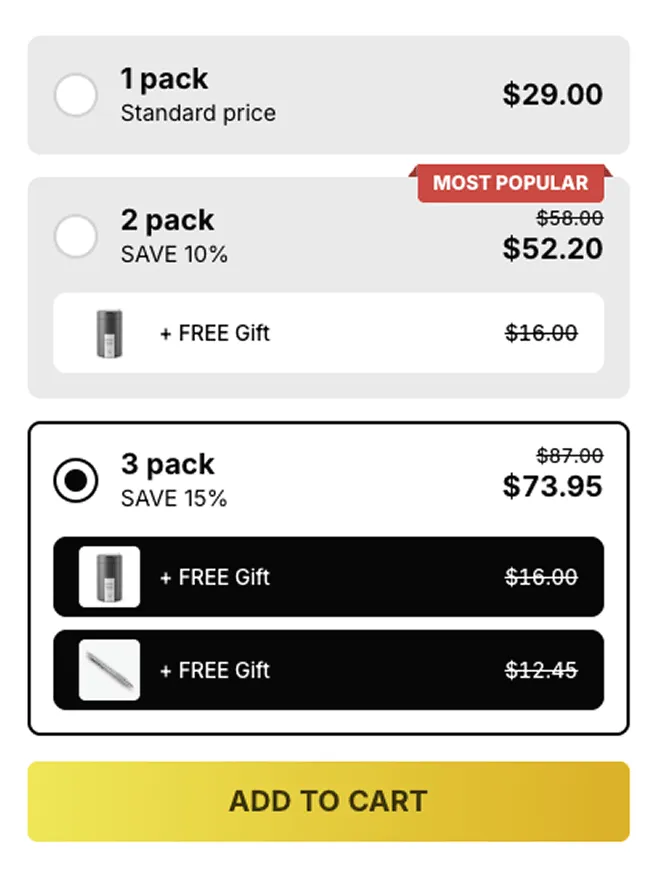
- Gift attached to an offer. "Buy the 3-pack, get a free travel pouch." In V Bundles, a free gift with purchase is attached to the bundle offer, the widget shows it before the shopper commits, and it goes to checkout with the offer once the conditions are met.
- Gift on a cart-wide spend threshold. "Spend $75, get a free gift." Shopify's native Buy X Get Y discount supports a minimum purchase amount with a free item, but Shopify notes that the free item is never added to the cart automatically. The customer has to add it, so say so clearly on the product page and in the cart.
The first option looks like this in V Bundles, with one gift attached to the 2-pack and two gifts on the 3-pack:
If you use a spend threshold, set it from your own numbers. Pull your average order value from Shopify Analytics and place the threshold noticeably above it. If your usual cart is $55, a $60 threshold changes little; $75 gives shoppers a real target. Our guide on how to increase Shopify AOV covers thresholds alongside other order-value tactics you can combine with gifts.
The best gifts are low cost and high perceived value: travel sizes, samples, accessories, or new products you want customers to try.
5. Mix and match: let shoppers build their own bundle
Quantity breaks assume the customer wants several units of the same thing. But if you sell eight coffee roasts, twelve candle scents, or twenty sock designs, many shoppers want three items, just not three identical ones.
A mix and match bundle solves that. You define the eligible products and the bundle price; the shopper picks the combination:
- Build your Black Friday 3-pack: choose any 3
- Regular total: $75
- Black Friday price: $59
This removes the most common objection to multi-buy offers ("I like the deal, but I don't need three of the same thing") and works for coffee, tea, candles, cosmetics, snacks, supplements, socks, apparel, and fragrances.
In V Bundles, the shopper fills an open bundle slot by choosing from the products you allow:
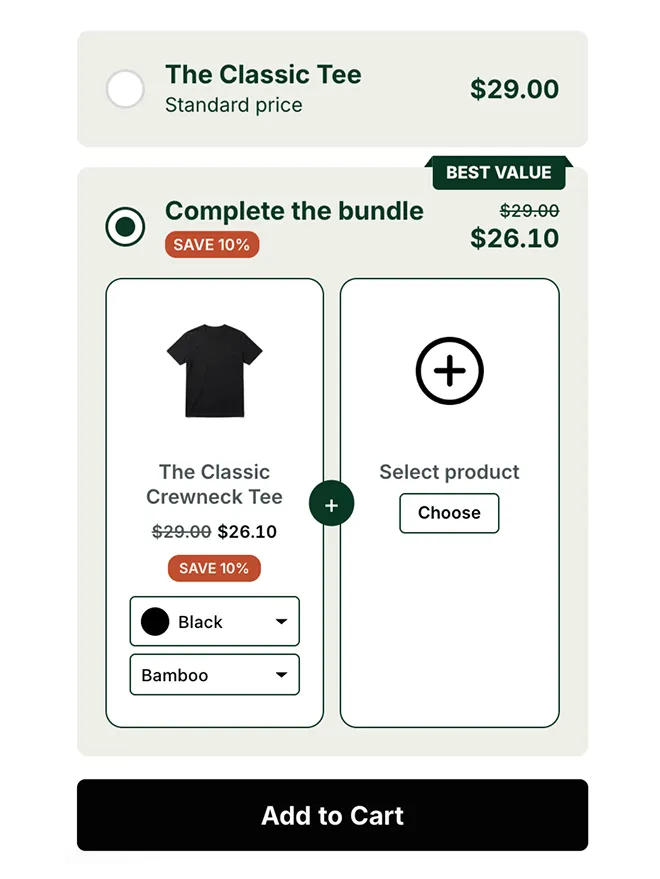
Limit the choice. Making your entire catalog eligible turns the bundle builder into a second collection page. A curated set of Black Friday favorites, say 8 to 12 products, keeps the decision quick, especially on mobile.
6. Add-ons and cross-sells: complete the purchase
Once a shopper has decided to buy, a small relevant extra is an easy yes. It does not ask them to make a new buying decision; it finishes the one they already made.
Good pairings are obvious ones:
- Camera and memory card
- Coffee maker and filters
- Shampoo and scalp brush
- Laptop and sleeve
- Skincare bundle and travel bag
- Supplement and shaker bottle
If a customer picks the $69 skincare bundle, a one-tick product add-on directly below it ("Add the travel bag for $9") is far easier than asking them to find the accessories collection, open another page, and come back. For products that are almost always bought together, a frequently bought together offer lets shoppers add the whole set in one click.
The word that matters is relevant. A random product next to the add-to-cart button is just another promotion competing for attention. One strong add-on beats five weak ones on a Black Friday product page that is already busy.
7. Subscription bundles: turn Black Friday buyers into repeat customers
Black Friday is usually treated as a one-time acquisition event. For replenishable products, it can also start a recurring relationship.
Instead of a single "15% off" offer, give shoppers two choices:
- One-time purchase: save 15%
- Subscribe and save: save 20%
The subscription gets the stronger incentive because its value to your business extends past the first order. Coffee, supplements, skincare, pet food, and razors are natural fits.
Two cautions. First, a Black Friday subscriber who signed up only for the discount may cancel after the first shipment, so judge the offer on retention after two or three cycles, not on sign-ups. Second, make the delivery frequency and cancellation terms unmissable. A shopper who feels tricked into a subscription costs you more in support and chargebacks than the subscription earns.
In V Bundles, subscription bundles show the one-time and subscribe-and-save prices side by side inside the widget and work with subscription apps built on Shopify's selling plans, such as Recharge, Bold Subscriptions, and Appstle. Subscriptions are available on paid plans.
Are bundles more profitable than a site-wide Black Friday discount?
Running a site-wide sale and bundles is not an either/or decision. The more useful question is: which orders does your discount reward?
The way to answer that is contribution per order: revenue minus product cost, fulfillment, shipping, and payment fees. Here is a worked example. The product sells for $40. Assume these costs (replace them with your own):
- Product cost: $12 per unit
- Fulfillment and packaging: $3 per order, plus $1 per extra unit
- Shipping: $7 per order, plus $1.50 per extra unit
- Payment processing: 3% of the order plus $0.30
| Order | Revenue | Total costs | Contribution |
|---|---|---|---|
| 1 unit at 25% off site-wide | $30.00 | $23.20 | $6.80 |
| 1 unit at full price | $40.00 | $23.50 | $16.50 |
| 2 units at 15% off (quantity break) | $68.00 | $38.84 | $29.16 |
| 3 units at 25% off (quantity break) | $90.00 | $54.00 | $36.00 |
The same 25% discount earns $6.80 on a one-unit order and $36 on a three-unit order. Product cost still scales with each unit, but several order-level costs do not. Shipping, packing, and the flat part of the payment fee are paid once per order, so they consume a much larger share of a small discounted order than a larger one.
Now add acquisition cost. Paid traffic gets more competitive during BFCM. If it costs you $15 in ads to win an order, the one-unit site-wide order loses $8.20, while the three-unit quantity-break order still keeps $21.
Two honest caveats. A quantity break only wins if some shoppers actually move up a tier; if nobody does, you have simply not discounted. And a flat site-wide discount is simpler to communicate, which can lift conversion. That is why many stores combine them: a modest site-wide offer (say 10%) with bundles as the clearly best-value way to shop.
Before you publish any Black Friday offer, fill in this table with your real costs. If a tier's contribution does not cover your expected acquisition cost plus the minimum profit you want to keep per order, it is too deep.
How to choose the right Black Friday offer
Start with the result you want, then pick the offer.
| Your goal | Offer to consider |
|---|---|
| More units per order | Quantity breaks |
| Higher cart value with complementary products | Fixed bundles |
| Move specific inventory | Buy X Get Y |
| Add value while protecting price | Free gift |
| Sell across many variations | Mix and match |
| More accessories per order | Add-ons and frequently bought together |
| Turn new buyers into repeat customers | Subscription bundles |
You do not need all seven. Two or three well-chosen offers, each on the products that suit it, are easier to build, test, and understand than a product page stacked with every promotion. A shopper should be able to answer three questions in a few seconds: What am I getting? How much am I saving? What do I need to do to get it?
If the offer needs a paragraph of terms before it makes sense, simplify it. Clear promises like "Buy more, save more," "Get the complete set for less," or "Pick any 3 and save" are enough.
Will your Black Friday discounts stack? Test before November
This is where Black Friday math breaks most often. A store runs a site-wide code, a quantity break, and a free shipping offer, and nobody checks what happens when a shopper uses all three.
On Shopify, discounts do not combine automatically. Each discount has its own combination settings, and when automatic discounts and discount codes are both active, Shopify can apply only the best eligible discount or combination to the cart. Customers can use up to five product or order discount codes and one shipping code on the same order.
That creates two failure modes:
- The stack is too generous. A 20% site-wide code combines with a "Buy 3, save 20%" bundle and free shipping, and your best-margin order becomes your worst.
- The stack is not generous enough. The shopper expects both the code and the bundle saving, only one applies, and they abandon the cart or contact support.
Decide deliberately which offers should combine, then test it. Add products to the cart in the combinations a real shopper would use, apply your Black Friday code, and check the final price at checkout. Repeat with your cart drawer app and on a phone.
A Shopify Black Friday preparation timeline for 2026
Ten weeks is enough time to do this properly, but not if building starts in November. Shoppers plan early as well: in the same Impact survey, almost a third of respondents said they start planning holiday shopping as early as September.
| When | What to do |
|---|---|
| Mid to late September | Pick your Black Friday products, pull your AOV and units per order, fill in the margin table, choose one offer per product group |
| Early October | Build the offers and preview them on desktop and mobile |
| October | Test tier depths and layouts on regular traffic, not on Black Friday itself |
| Late October | Test discount combinations, cart drawer apps, markets, and gift logic at checkout |
| Early November | Finalize copy, labels, product targeting, and inventory; prepare email and ad creative around the bundles |
| November 16-22 | Final QA on a real phone; no structural changes after this week |
| November 26 | US Thanksgiving; consider early access for email subscribers |
| November 27 | Black Friday |
| November 30 | Cyber Monday |
| Early December | Review which offers moved people up a tier, then switch to holiday gift bundles |
A few V Bundles features are worth using in this window. A/B split testing splits traffic between bundle variants, so you can compare a 10/20% tier structure against 15/25% in October and go into Black Friday with data instead of a guess. Market-specific bundles let you show a Black Friday offer only in markets where it makes sense, for example the US and Canada, while other markets keep their regular pricing.
Mobile deserves its own test pass. On Cyber Monday 2025, 57.5% of US online sales came through a mobile device, according to Adobe. Long product pages push the offer far above the shopper's scroll position, and a sticky add to cart button keeps the bundle reachable while they read reviews and details.
Black Friday bundle launch checklist
Run through this list before November 20:
- Every offer has a filled-in margin table with real product, shipping, and fee costs
- The deepest tier's contribution still covers your expected acquisition cost plus your minimum profit per order
- Discount combinations are set deliberately and tested with your Black Friday code
- Free gifts show clearly, and threshold gifts tell shoppers to add the item themselves
- Bundled products have enough inventory for the weekend
- Offers display correctly on a real phone, not only in a desktop preview
- The full checkout works with your cart drawer app and in every market you sell to
- Subscription terms and cancellation steps are visible before purchase
Start building your Black Friday bundles now
The best Black Friday bundle is the one you built early enough to test. Use quantity breaks when buying more of the same product makes sense, fixed bundles when products belong together, BOGO and free gifts when your margins allow, mix and match when customers want variety, and relevant add-ons where they complete the purchase. Then check the math, test the discount stack, and keep the offer clear.
V Bundles lets you build quantity breaks, fixed and mix and match bundles, Buy X Get Y deals, free gifts, add-ons, and subscription bundles from one app, with a free plan to get started. Build your offers in September and October, and they will be tested and ready before the Black Friday traffic arrives.
About the numbers: cost figures in the examples are illustrative, so replace them with your own. Market statistics link to their primary sources (Shopify, Adobe, Impact, and the Shopify Help Center) and were checked in September 2026. Dates and consumer data are US-focused; the offer strategies apply to any Shopify market. We will update this guide with BFCM 2026 results in December.